
Your brand is perhaps your professional services firm’s most valuable asset. If this is true, then developing a stronger brand is your most important task (that’s why we developed our Brand Building Guide). Not convinced? Consider what a professional services brand is.
What is Brand Development?
Brand development is the process of creating and strengthening your professional services brand. As we help firms develop their brands, we divide the process into three phases.
- The first phase is getting your brand strategy right and aligned with your business objectives.
- Second is developing all the tools you will need to communicate the brand, such as your logo, tagline and website.
- Finally, there is the phase of strengthening your newly developed or updated brand.
Your brand development strategy is how you go about accomplishing these tasks. To make the task a bit easier, we’ve broken the brand development strategy into 10 steps.
Your Brand Defined
A professional services brand is best understood as your firm’s reputation and it’s visibility in the marketplace. The strength of your brand can be measured as Reputation X Visibility.
There is another important dimension of your brand as well: how relevant it is to your target client audience. More about that later.
A 10-Step Brand Development Strategy
1. Consider your overall business strategy.
A strong, well differentiated brand will make growing your firm much easier. But what type of firm do you want? Are you planning to grow organically? Your overall business strategy is the context for your brand development strategy, so that’s the place to start. If you are clear about where you want to take your firm, your brand will help you get there.
2. Identify your target clients.
Who are your target clients? If you say “everybody” you are making a very big mistake. Our research clearly shows that high growth, high profit firms are focused on having clearly defined target clients. The narrower the focus, the faster the growth. The more diverse the target audience, the more diluted your marketing efforts will be. So how do you know if you have chosen the right target client group? That’s where the next step comes in.
3. Research your target client group.
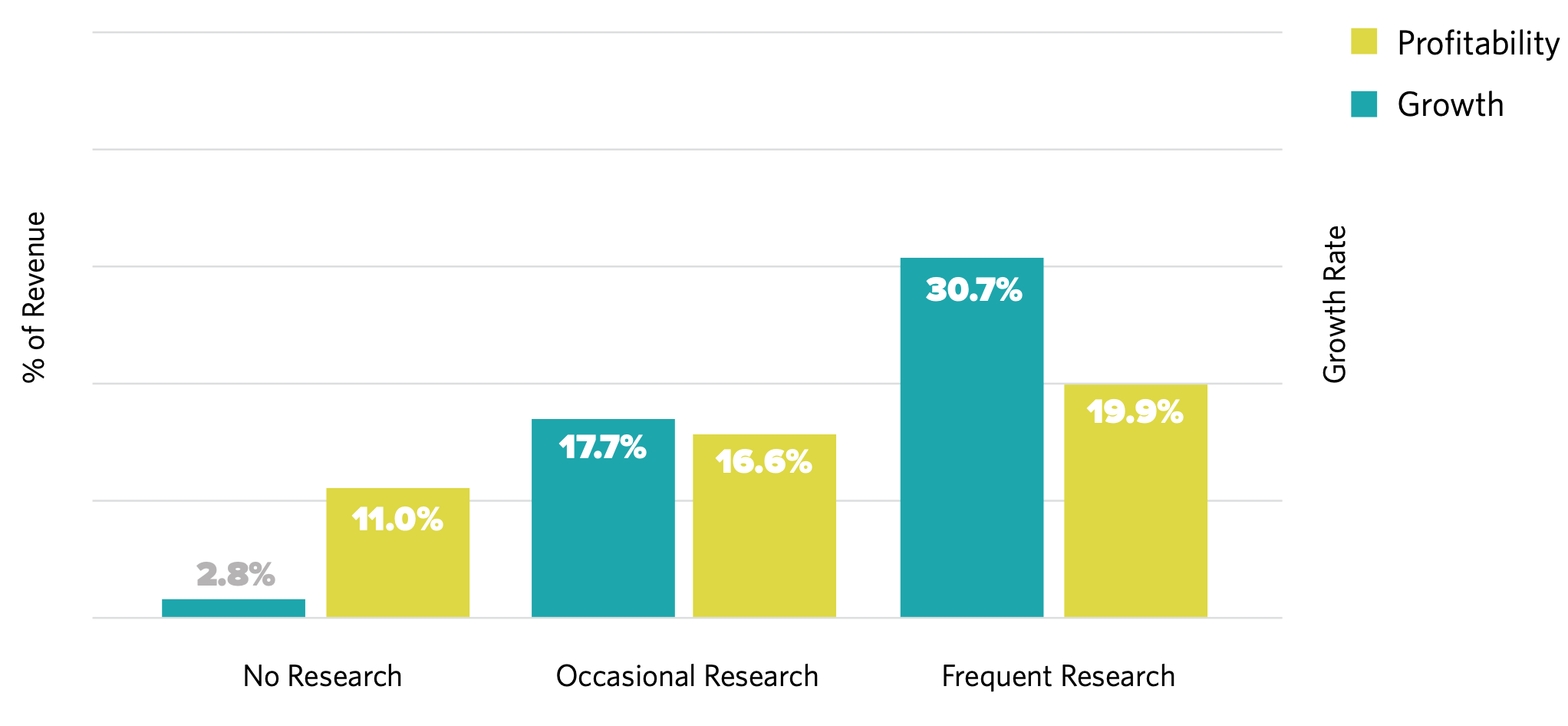
Firms that do systematic research on their target client group grow faster and are more profitable (see figure below). Further, those that do research more frequently (at least once per quarter) grow faster still.
Research helps you understand your target client’s perspective and priorities, anticipate their needs and put your message in language that resonates with them. It also tells you how they view your firm’s strengths and your current brand. As such, it dramatically lowers the marketing risk associated with brand development.

4. Develop your brand positioning.
You are now ready to determine your firm’s brand positioning within the professional services marketplace (also called market positioning). How is your firm different from others and why should potential clients within your target audience choose to work with you?
A positioning statement is typically three to five sentences in length and captures the essence of your brand positioning. It must be grounded in reality, as you will have to deliver on what you promise. It must also be a bit aspirational so you have something to strive for.
5. Develop your messaging strategy.
Your next step is a messaging strategy that translates your brand positioning into messages to your various target audiences. Your target audiences typically include potential clients, potential employees, referral sources or other influencers and potential partnering opportunities, to name a few of the usual suspects.
While your core brand positioning must be the same for all audiences, each audience will be interested in different aspects of it. The messages to each audience will emphasize the most relevant points. Each audience will also have specific concerns that must be addressed, and each will need different types of evidence to support your messages. Your messaging strategy should address all of these needs. This is an important step in making your brand relevant to your target audiences.
6. Develop your name, logo and tagline.
For many firms, a name change is not required. But if you are a new firm, are undergoing a merger or are burdened with a name that no longer suits your positioning, a name change may be in order. Even if you don’t change your firm name, a new logo and tagline may make sense to better support your brand positioning.
Remember, your name, logo and tagline are not your brand. They are a part of your brand identity, the ways to communicate or symbolize your brand. You must live it to make it real.
And don’t make the mistake of showing the new logo around internally to get a consensus. The name, logo and tagline are not for you. They are for your marketplace and should be judged on how well they communicate, not how much the partners like them.
7. Develop your content marketing strategy.
We could have called this step “develop your marketing strategy.” But we didn’t. Instead we call for a content marketing strategy.
Why? Content marketing is particularly well suited to professional services firms in the Internet age. It does all things traditional marketing does but it does them more efficiently. It uses valuable educational content to attract, nurture and qualify prospects.
Remember that your brand strength is driven by both reputation and visibility. Increasing visibility alone, without strengthening your reputation, is rarely successful. That’s why traditional “awareness-building” advertising or sponsorships so often yield disappointing results. On the other hand, content marketing increases both visibility and reputation at the same time. It is also the perfect way to make your brand relevant to your target audiences. Case closed.
8. Develop your website.
Your website is your single most important brand development tool. It is the place where all your audiences turn to learn what you do, how you do it and who your clients are. Prospective clients are not likely to choose your firm solely based on your website. But they may well rule you out if your site sends the wrong message.
Further, your website will be home to your valuable content. That content will become the focus of your search engine optimization (SEO) efforts so that your prospects, potential employees, and referral sources will find you and learn about your firm. Online content is central to any modern brand development strategy.
These days, professional services websites come in two varieties. The first is a branding site. Such a site tells your story and conveys who you are, who you serve, and what you do. In short it conveys your brand message. The other variety does the above and also generates and nurtures potential new clients. We call these High Performance Websites.
9. Build your marketing toolkit.
The next step in the process is to build out the remainder of your marketing toolkit. This might include one-page “sales sheets” that describe core services offerings or key markets served. In addition, there may be a brief “pitch deck” that overviews the firm or key offerings and an e-brochure about the firm. These are rarely printed pieces anymore.
Increasingly this marketing toolkit also includes videos. Popular video topics include firm overviews, case studies or “meet the partner” videos. Key services offerings are also very useful. If prepared appropriately, these tools serve not only a business development function but also are important for brand development.
10. Implement, track, and adjust.
This final step in the brand development process may be one of the most important. Obviously a winning brand development strategy doesn’t do much good if it is never implemented. You might be surprised at how often that happens. A solid strategy is developed and started with all the good intentions the firm can muster. Then reality intervenes. People get busy with client work and brand development tasks get put off… then forgotten.
That’s why tracking is so important. We strongly recommend tracking both the implementation of the plan as well as results. Did the strategy get implemented as planned? What happened with the objective measures, such as search traffic and web visitors? How many new leads, employee applications and partnering opportunities were generated? Only by tracking the entire process can you make sure you are drawing the right conclusions and making the right adjustments.
There you have it — a 10 step brand development process to drive the growth and profitability of your firm.
A Brand Development Example
Let’s consider the following real-world example of brand development. Heller Consulting is a technology consulting firm for nonprofits that approached Hinge when their marketing program was not delivering the results they desired. As a brand, they struggled to define themselves in the marketplace.
We began our engagement with research to understand how Heller was perceived by their prospects and clients. One discovery from this research was that their brand had unintentionally developed a narrow reputation as fundraising technology experts. They wanted to be known for more. With this brand research in hand, we were ready to proceed to the next phase of the brand development process.
We used what we learned about their firm’s strengths and how they compared to the competitive landscape to develop a set of key differentiators. This exercise led to the development of a compact positioning statement and persuasive messaging they could use in all their marketing materials.
One of the key areas where this new marketing language needed to be reflected was on the Heller website. Hinge helped Heller redevelop their website for an improved user experience and to incorporate they new positioning and messaging. We also made it easier to find and consume their thought leadership—gating the most valuable content to help turn web visitors into leads. It was now easier than ever for Heller to be identified and known as a thought leader in their space.
The results? Heller experienced a 400% increase in website conversions and a 50% increase in organic search traffic after a two year period. “Hinge gave us the foundation for a powerful, long-term marketing program,” said Heller COO Smita Vadakekalam.

How Hinge Can Help
An effective brand development strategy needs to connect with the new professional services buyer. Hinge’s Branding Program can help your firm stand out from the competition and build a brand that drives sustained growth.
Additional Resources
- Get strategies, tips, and tools for developing your firm’s brand with Hinge’s Brand Building Guide for Professional Services Firms.
- Download a free copy of the Inside the Buyer’s Brain, Fourth Edition research report to learn how to build a powerful brand to help your firm close more sales.
- Uncover your firm’s true differentiators and give buyers a reason to pick you out of the crowd in Differentiation, Positioning & Messaging through Hinge University.