
Way back in 1969, a very perceptive marketer named Jack Trout introduced the concept of brand positioning to the world. He was the first to put a word to a very powerful marketing effect. A few years later, he and Al Ries wrote the seminal book, Positioning: The Battle for Your Mind, and the rest is history.
Now, more than half a century later, the concept of positioning is just as relevant to businesses — and probably more so. If anything, today’s professional services marketplace is much larger and more crowded. Buyers have a bewildering array of firms to choose from, and with the rise of the Internet, local firms are contending with companies across the nation, if not the world.
What’s a firm to do? How do you compete when there’s barely room to breathe?
That’s where brand positioning comes in. It gives you space in the marketplace to command the attention of your best prospects.
What Is Brand Positioning?
Brand positioning is the process of differentiating your firm from competitors in the minds of your audience—and giving them a reason to buy from you. It involves connecting something that your buyers want with a thing your firm provides. This mental association defines your firm, so it must be simple enough to grasp in today’s over-communicated world, relevant to your buyers and different from the way your key competitors talk about themselves.
Let’s consider a couple of examples of brand positioning.
What do you think of when you read the words, “soda,” “soft drink” or “pop”? Did Coke or Pepsi come to mind? These two products are positioned to dominate the soft drink category.
Now let’s try a service. What company do the words “overnight shipping” make you think of? Even though other companies offer overnight delivery, FedEx owns that category — it has built its entire identity and operations around doing it better than anyone else.
In theory, any professional services firm can build a strong association between their brand and an idea. But to be successful, your positioning must be 1) different (it’s tough to take over a leadership position already held by another business); and 2) visible (if nobody has heard of your firm, your positioning can’t take root).
A good way to work out your brand positioning is to create a brand positioning statement. We’ll explore that process a bit later.
Why Brand Positioning Is Important
What do firms gain when they position their services and products well? When you have a well-defined brand position, your firm has many advantages. Positioning can provide a conceptual template for your brand, your marketing messages, the services you offer and even the way you structure your pricing.
Here are a few of the key benefits of brand positioning:
- It focuses you on a specific target market. When you provide a limited set of services to a limited audience, your marketing becomes sharper and more effective. Almost automatically, your expertise becomes more valuable.
- It clarifies how you are different from competitors. You’ll finally know exactly what sets you apart and be able to talk about your firm in a way that gets prospects excited.
- It shows you how to win new clients. Positioning arms your business development team with critical arguments they can use in the nurturing and closing processes.
- It drives your messaging. Talking about your firm is easy when your positioning is clearly defined.
- It presells your services. When you have strong positioning, you become the choice against which everyone else has to compete.

5 Types of Brand Positioning Strategy
Positioning strategies can take many forms, but not all are appropriate for professional services firms. Below are five strategies that are most relevant to positioning a firm like yours:
- Cost-driven positioning. “We offer everything those other firms do, but we cost less.” This is a very challenging strategy unless you have an inherent cost advantage. Technology can be your best friend if you are able to use it more effectively than your competitors.
- Niche service specialization. In this strategy, you focus on offering a specific service or narrow range of services. As a specialist, you are able to provide a depth of expertise that a generalist would not have. This approach can work well unless other equally capable specialists enter the market, diluting your “specialness.”
- Industry specialization. Industry specialists focus on a particular industry or set of related industries. It allows you to tightly focus your marketing and evolve your services as your market changes. This approach comes with risks, however. If your industry experiences an economic decline, your fortunes may follow. It is also easy for new competitors to enter the fray and disrupt your positioning. However, market leaders can be difficult to unseat, so specialists that hold a first-mover or leadership position have a powerful advantage.
- Role-focused specialization. “We help Chief Technology Officers succeed” is an example of role-focused positioning — targeting a particular function in the organization. Instead of specializing in a particular industry or service, you target a cohort of people. These buyers will perceive you as more tuned in to their needs and assume that you offer specific knowledge or expertise that will make their job easier.
- Quality of service positioning. This is one of the most common strategies used by professional services firms, and (with rare exceptions) it is one of the least effective. “Nobody’s more committed to quality,” “We deliver the best service” and similar messages are so ubiquitous in the marketplace that they utterly fail to impress buyers. Of course, buyers do want quality and customer service — but these traits are expected and they are rarely criteria used to select a firm.
Brand Positioning Examples
What does a well-positioned firm look like? Below we include a few examples of how some of our own clients have positioned themselves in the marketplace. These examples represent the purest distillation of their brand positioning—simple ideas that anyone in the marketplace can understand but which are difficult for competitors to copy.
Vault Consulting
“The nation’s leading accounting and research firm for nonprofits and associations.”
Why it works: Vault’s unusual combination of accounting and research services, in conjunction with their industry focus, allows them to claim leadership status.
Sellers Dorsey
“The nation’s leading Medicaid consultancy to health care providers, payors and state governments.”
Why it works: They do just one thing: Medicaid consulting. And they have built a market leadership position around that specialization.
20-20 Services
“We focus on just one thing: equipping today’s accounting professionals with all the skills, knowledge and leadership training they need to thrive and grow.”
Why it works: They focus on a constant need in the CPA industry: keeping accounting professionals fully trained and equipped to build their business.
What Is a Brand Positioning Statement?
A brand positioning statement is a succinct, easy-to-understand paragraph that describes your firm’s positioning in the marketplace. It should address three questions: 1) What do you do? 2) Who do you serve? 3) How are you different from similar firms in the marketplace? It may also include other key reasons clients prefer your firm over others.
A brand positioning statement is primarily an internal document that a firm’s marketing and business development teams can use to craft differentiated marketing language—though some of its language may be used verbatim in public-facing messaging. In Step 4 below, we explain how to write your own positioning statement.
The Brand Positioning Process
Ready to develop a brand positioning strategy for your own firm? The steps below will give you a solid roadmap to get there. I’ve also included links to other resources that will help fill in some of the details. Let’s get started!
Step 1. Start with your overall business imperatives. What are you trying to accomplish as a firm? Your positioning is a fundamental pillar of business strategy, and it affects how you will drive growth and attract the talent you need to sustain your expansion. If you don’t have your business goals written down already, sit down with your management team and make sure everyone agrees on a clear set of priorities. That way, when you begin formulating your positioning statement you will have a clear destination in mind.
Step 2. Research your target clients and competitors. Firms that have a strong understanding of their audiences and competition are more than twice as likely to be high-growth businesses (those that grow at least 20% year over year). The best way to acquire this understanding is to conduct brand research.Typically, it is conducted by an independent research organization to ensure the data collected is confidential, which encourages participants to provide more honest feedback. Brand research usually involves interviewing current clients, prospects, and referral sources. It can also include an analysis of your competitors — how they describe themselves and how your audience perceives them.
Brand research can also identify strengths and weaknesses you weren’t able to see before. In addition, you’ll learn what factors potential clients value most during the selection process.
And brand research is critical to the success of the next step.
Step 3. Identify your differentiators. This is where your business goals and brand research turn into marketing gold. Drawing on the insights of your team, external perceptions of your firm and a new understanding of your competitors’ positioning, you will pick out characteristics that both set you apart from your competition and are of great interest to prospective clients.
Strong differentiators must also meet three other criteria: they must be 1) true, 2) provable and 3) relevant to your target audience. If a differentiator isn’t true, clients will often sense it and approach your firm with skepticism. That’s why you should be able to support each differentiator with evidence. Often you will uncover proof in your brand research. For example, a finding that “9 out 10 clients refer us to others” is a statistic you could use to support a variety of differentiators).
Some differentiators may be characteristics that you discover in your research (“clients find us to be highly flexible”), while others may be a specialization that you have already cultivated (“we provide network security services exclusively to accounting firms”). If you find your existing differentiators lacking, you may decide to pursue a new area of focus or concentrate on a particular area of strength. While this approach may be aspirational at first, it can work so long as you truly commit your firm to it and can demonstrate you are doing it going forward. If you are struggling to think of possible differentiators, consult this list of 21 professional service differentiators for ideas. Or, take a look at this list of the 12 worst differentiators for professional services firms to make sure you are fooling yourself.
To learn more about uncovering your differentiators, check out our free Differentiation Guide for Professional Services Firms. Also, I suggest you read this blog post on competitive differentiation.
Step 4. Craft your brand positioning statement. Now it’s time to translate your differentiators into a story that clearly communicates your competitive advantage. A positioning statement distills your key buying propositions into a short paragraph. It’s an internal document. Because it compresses a lot of information into a few sentences, it’s not intended to be used verbatim on your website or in your marketing materials. Instead, think of it as a source you can return to again and again when you need the inspiration to describe your firm, explain how you are different or persuade people to buy from you.
A brand positioning statement can take two different forms: a crafted paragraph or a prompted statement. Developing a crafted paragraph takes more skill and time, but some firms find that it translates more easily into marketing messages. A prompted statement is faster and simpler to assemble: your team fills in the blanks with the appropriate information.
Here’s an example of a positioning statement in paragraph form:
Newco is the nation’s leading IT consultancy that specializes in law firms and legal departments. Our team of attorneys, engineers, CIOs, executive directors, and project managers is uniquely positioned to make your practice more productive and profitable. We’re familiar with the hundreds of software applications used by the legal community, and we’ve developed a suite of tools that makes migrating and configuring systems faster and more efficient. We also have a reputation for doing a job once and doing it right — that’s why 4 out of 5 clients put us on a long-term contract. When you need the best legal IT strategy, implementation and support, Newco is the easy choice.
As you can see, this type of positioning statement is your brand stripped down to its essentials. If you got the differentiators right at the beginning and you understand your audience, this should be more an exercise in prioritizing and word choice than creative engineering.
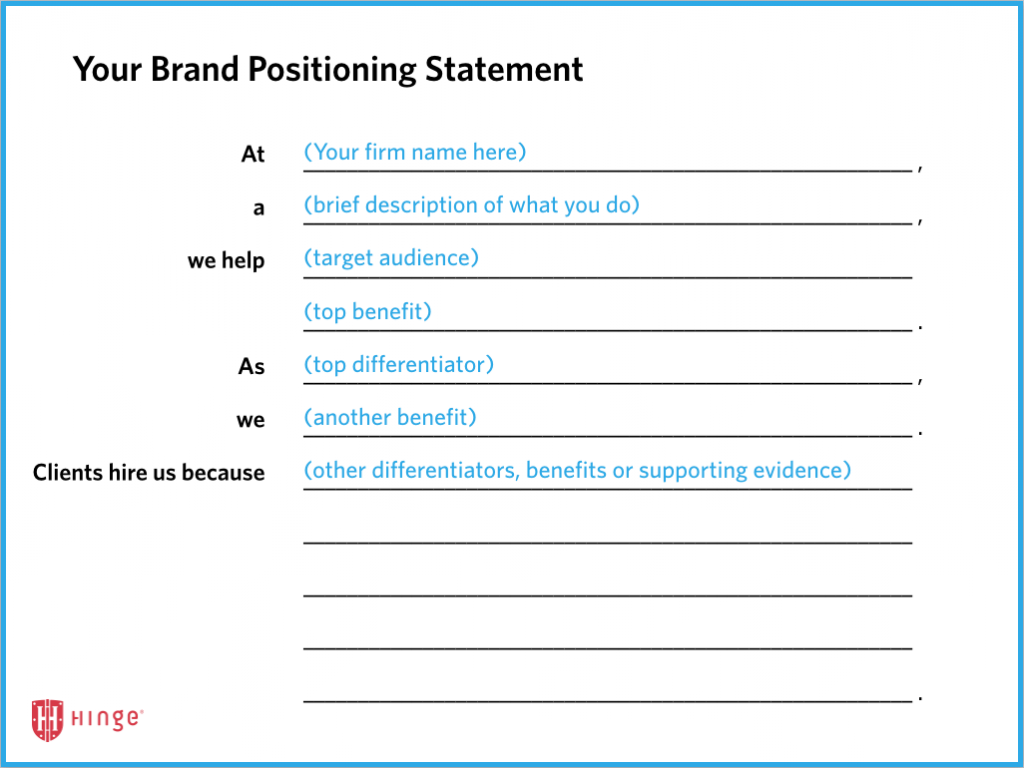
In contrast, a prompted positioning statement is simpler and more telegraphic. Here’s what a prompted statement template, ready to be filled out, looks like:
If Newco had used the prompted statement, this is how it might read:
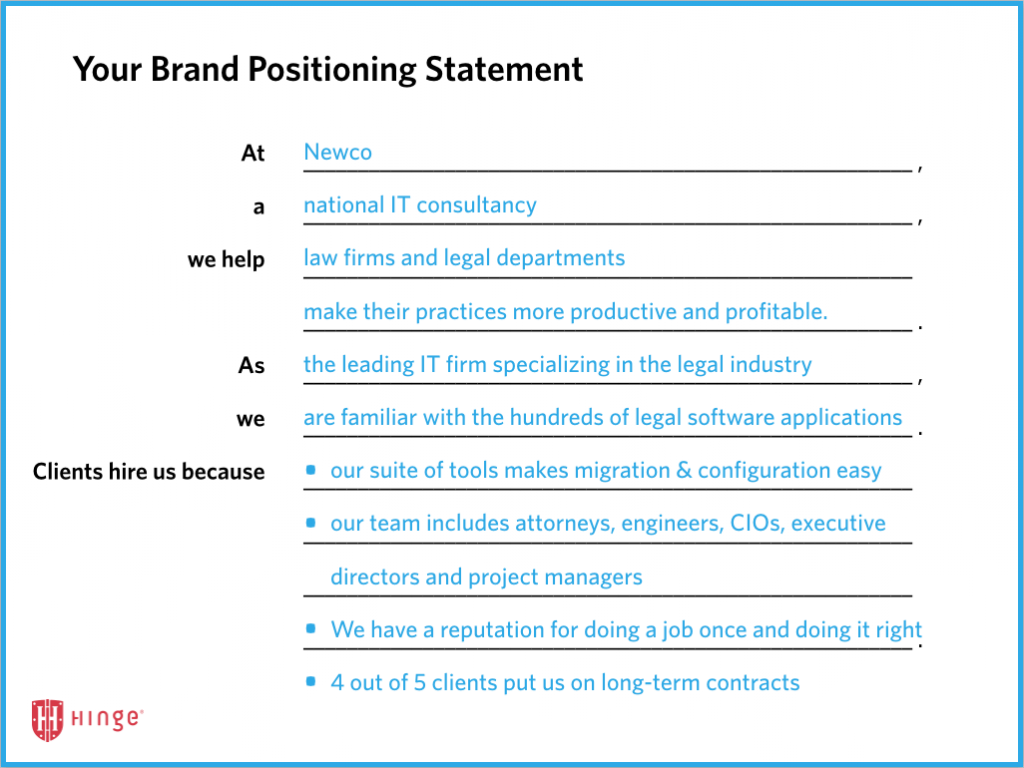
While a prompted statement is easier to create, its simplicity makes it less convenient as a source of ready-made marketing messages. While you can pull carefully crafted language verbatim from a positioning paragraph, that’s not usually possible from a prompted statement. Both, however, provide the raw materials to write new messages.
Whichever format you choose, your brand positioning statement should include the following elements:
- Your firm name
- What you do
- Who you serve
- What makes you different
- Proof that supports your claims
Okay, let’s break down the Newco example and make sure we’re covered.
What’s their name? Newco. (Check!)
What services do they provide? IT consulting services.
Who is their target audience? Law firms and legal departments.
What makes them different from competitors? They work exclusively with legal practices, so they are industry specialists. This gives them an advantage when pursuing business with law firms and legal departments over generalist IT firms that serve multiple industries. They also claim to be the leaders in their niche.
What else supports their positioning? They have developed a proprietary suite of tools that allows them to do their job more efficiently than their competition. And because their team includes professionals who have been in their clients’ shoes (attorneys, CIOs, executive directors) they are well attuned to their needs. They also have a great reputation, which they can demonstrate by citing the high percentage of clients that put them on long-term contracts.
So how do you use your brand positioning statement? The first thing many firms do is develop their elevator pitch — that short description of your firm that answers the question, “What does your firm do?” Keep your elevator pitch short — a sentence or two will usually do the trick — and write it in natural, conversational language. If people were to memorize it, it should sound like something a person would actually say.
You can also use your positioning statement as the foundation of your messaging architecture. Your messaging architecture is a document that spells out key messages for each of your audiences and addresses specific objections they may have. For example, “Why would I choose your firm over a better-known competitor?”
Finally, you will use your positioning statement as inspiration for headlines and persuasive language on your website and in marketing collateral.
Step 5. Implement your new positioning. No strategy, no matter how well-conceived, will survive poor implementation. You have to have the right communications tools in place — pieces that will support the new message you are delivering. And that may require revisiting everything you use to market your services. At the very least, you will want to reflect your new positioning in your marketing materials and website.
For some firms, however, implementation involves rethinking their overall identity or initiating a rebranding process. This process can involve a soup-to-nuts overhaul — a new name, tagline, logo, website, marketing materials, and more. Typically, this happens when a firm either undergoes a change in strategy or realizes that its brand is out of date and no longer reflects the caliber of the firm they have become.
As you develop your new positioning, think about how you will convey that message to the world. What needs to change, what can stay the same, and what new components need to be introduced?
Overcoming Positioning Challenges
Repositioning your firm isn’t necessarily easy. It depends on the raw materials you have to work with and the mindset you bring to the process. Some firms discover that they just don’t have strong differentiators. In this all-too-common situation, a firm has four options:
- Embrace a new focus in an underserved area. This is the most effective — and difficult — option. It almost always means letting go of one or more client segments to build momentum and mind-share in another. If you think you can pull it off, pursue this approach with all the energy you have. It can pay huge dividends.
- Own a trait. Identify an aspect of your business that you would like to associate with your firm. It’s okay if competitors do it, too — so long as nobody else is using it in the same way. For example, an architecture firm client of ours uses industry research to inform its design process. This “evidence-based design” approach isn’t new, but it’s not universally practiced, and none of their competitors were talking about it. So the firm decided to own it. As part of their brand positioning strategy, they began using the word “scientific” to describe their design philosophy. By tying their approach to science, they could begin building a reputation as the most methodical and credible option in their market.
- Combine two traits. This is a mashup of options 1 and 2 above. Select two primary traits or functions of your business and combine them. You may be able to claim that you are the leader at the intersection of those two things. For example, we positioned an accounting firm as “the nation’s leading specialist in fair market valuations and financial transaction consulting to the healthcare industry.” Since no other firm was preeminent in providing both of those services to the healthcare industry, our client could credibly call itself a leader.
- Do nothing. Or promote weak differentiators, which amounts to the same thing. You can say that you hire only the best people, or that you deliver the best customer service, but nobody will care.
Brand Positioning Strategy Examples
Professional services firms often struggle to differentiate and position themselves. So I’d like to end this piece by examining a handful of real-world examples of brand positioning strategy — specifically, how firms in different industries have used positioning strategy to become more competitive, grow faster and be more profitable.
Accounting
Tablespoon is a Dallas-based accounting firm. At first (under a different name), they were a typical general accounting firm with a diverse range of business clients. Their fortunes turned for the better when they decided to pivot and specialize in serving one of their strongest client segments: restaurants. Over time, they decided to narrow their focus, even more, to concentrate on chain restaurants. Today, they are thriving and growing in their highly specialized area of expertise. “It’s taken us to a whole new level of success,” says CEO, Andrew Lester.
Brand positioning: The accounting firm for multi-location restaurants.
Executive Search
Melissa Henderson was a Managing Director at a large, international search firm when she had a crazy idea. What if C-level executives could hire their own personal representative, much like an elite sports agent? It would turn the executive search industry on its head. (Conventional executive search firms are paid by companies who are looking for talent, not by the job seekers.) So Melissa left her job and founded Summit Executive Resources, a firm that helps top executives find the leadership and board positions they have always wanted — with the high-touch personal service they deserve.
Brand positioning: The personal search firm for C-level executives.
Healthcare Consulting
Ascendient is a top-50 consulting firm that serves hospital systems around the nation. Led by a team of practitioners and academics, they have a unique perspective on the future of healthcare. In fact, they believe most healthcare systems are not prepared for the massive changes that are about to transform the marketplace. To make their perspective more visible and differentiate their firm from consultants that focus primarily on today’s problems, Ascendient decided to reposition its firm around its future vision.
Brand positioning: We’re rethinking the future of healthcare.
Architecture
Populous is a global architecture firm that specializes in stadiums, convention centers and major special events. Begin in 1983 as the sports arm of architecture firm HOK, it was acquired in a management buyout in 2009. Today, Populous is the undisputed leader in the design of sports and entertainment venues.
Brand positioning: We design the places where people love to be together.
Legal
Walsh Colucci Lubeley and Walsh is a law firm outside Washington, DC. For decades, they were a general law firm with a strong practice in zoning and land use. But when the top firm in that space dissolved, their leadership recognized an opportunity and quickly rebranded their firm as The Land Lawyers. While they continue to offer a few general legal services, Walsh Colucci focuses their brand message squarely on its area of strength. Today, they have become the region’s dominant player in commercial real estate law.
Brand positioning: Northern Virginia’s premier commercial real estate law firm.
Conclusion
Most professional services firms are poorly positioned in the marketplace. They believe that they can get more clients by opening their arms wide to everyone — the broader their reach, the more business will float into their embrace. But that’s not what really happens. When buyers look around and see splayed arms everywhere, they have nowhere to gravitate.
That’s why having a brand positioning strategy is so important. It gives your prospects something to get interested in — and will ultimately convince them to buy from you. Your target audience will find you many times more fascinating than a generalist firm because you have the specialized expertise they need. And as a specialist, you can often charge more, to boot.
If your firm isn’t positioned to consistently attract premium clients, take heart. You’re not alone. Any firm can sharpen its positioning and build an enviable competitive advantage. All it takes is a little courage to take the first step.



How Hinge Can Help
Identify competitive differentiators that will help your firm stand out from the competition and build a brand that drives sustained growth with Hinge’s Branding Program.
Additional Resources
- Get strategies, tips, and tools for developing your firm’s brand with Hinge’s Brand Building Guide for Professional Services Firms.
- Download a free copy of the Inside the Buyer’s Brain, Fourth Edition research report to learn how to build a powerful brand to help your firm close more sales.